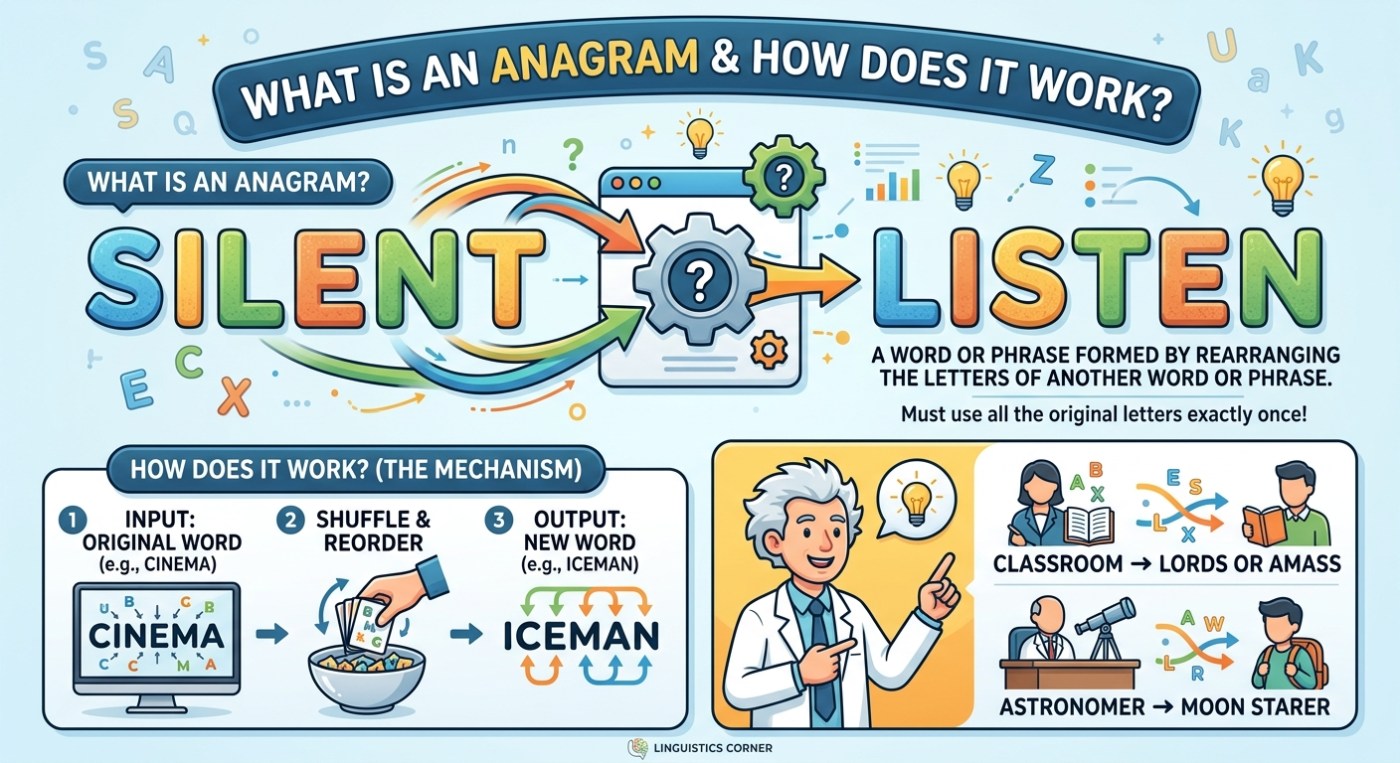
An anagram is a word or phrase made by rearranging the letters of another word or phrase. You use all the original letters, but you change their order to create something new.
For example, the word listen can be rearranged to form silent. Both words contain the same six letters, with one “e,” one “i,” one “l,” one “n,” one “s,” and one “t.”
Anagrams are more than word games. They’re used in puzzles, riddles, creative writing, name ideas, quizzes, and language practice. They can also help you see familiar words in a new way.
So, how do anagrams work? What rules should you follow? And how can you find one quickly? Let’s break it down.
What Is an Anagram?
An anagram is formed when you rearrange the letters of a word or phrase to create another word or phrase.
The key rule is simple: the letters must stay the same.
You can move the letters into a different order, but you can’t add or remove letters.
Here are a few easy examples:
- listen → silent
- evil → vile
- dusty → study
- save → vase
- angel → glean
Take dusty and study. The letters are identical. They only appear in a different order.
Anagrams can involve a single word or several words. In phrase anagrams, spaces and punctuation are usually ignored when comparing the letters.
How Does an Anagram Work?
The basic idea is much like mixing a set of letter tiles.
Imagine you have the letters in EARTH:
E, A, R, T, H
You can shuffle them into different orders. One valid anagram is HEART.
The new word doesn’t need to look like the old word. What matters is the letter count.
This gives us the main rule of anagram solving:
Every letter in the original must appear the same number of times in the result.
That last part matters.
For example, TEAM and MEAT are anagrams because both contain:
- One T
- One E
- One A
- One M
But TEAM and MEET aren’t anagrams. The letter counts don’t match.
The Letter Count Test
When you’re not sure whether two words are anagrams, compare their letters.
Let’s test SILENT and LISTEN.
Both have:
S = 1
I = 1
L = 1
E = 1
N = 1
T = 1
The counts match, so the words are anagrams.
Now compare STONE and NOTES.
Both contain five letters, but letter count matters more than length alone:
S = 1
T = 1
O = 1
N = 1
E = 1
The second word has the same counts. It’s a valid anagram.
This method is useful because it removes guesswork. Two words can look different and still be anagrams.
What Are the Main Types of Anagrams?
Not every anagram is used in the same way. Some are simple word pairs, while others are made for humor, clues, or hidden messages.
Exact Word Anagrams
These are the easiest to spot. One word is rearranged to make another word.
below → elbow
Both words use the same five letters.
Phrase Anagrams
A phrase can also be rearranged into another phrase. Spaces don’t count as letters, so the words may break apart and reform in a new way.
Phrase anagrams can be much harder to solve because there are more possible letter combinations.
They’re common in puzzles and word challenges.
Name Anagrams
Names can be rearranged to form other words or phrases. Writers and puzzle makers sometimes use this trick to create unusual names or hidden clues.
A name anagram can also make a fun theme for a game, story, or character.
Funny or Clever Anagrams
Some anagrams are designed to create a joke or an unexpected meaning.
These often work best when the new phrase has a strong connection to the original phrase, but in a surprising way.
That’s one reason anagrams are popular in wordplay. The letters stay fixed while the meaning changes.
How to Make an Anagram Step by Step
Creating an anagram by hand can be easy for short words, but longer words take more work.
Step 1: Write Down the Letters
Start with the original word.
Let’s use:
READ
Write the letters separately:
R, E, A, D
Step 2: Look for Common Letter Patterns
Think about common word endings and beginnings.
For example, READ can be rearranged to form DEAR.
The same four letters produce a different word.
Step 3: Check the Letter Count
Make sure you didn’t use a letter twice or leave one out.
DEAR contains:
D = 1
E = 1
A = 1
R = 1
Everything matches.
Step 4: Check the Meaning
A valid anagram should form a real word or phrase when the task calls for a meaningful result.
Not every possible letter order creates a word.
That’s why anagram solving is more than random letter mixing. You need to recognize patterns, vocabulary, and word structure.
How Do Anagram Generators Work?
Finding every useful arrangement by hand becomes difficult as the number of letters grows.
An anagram tool can speed things up by processing the letters and comparing possible combinations with a word list.
For example, a tool can take the letters from CARE and search for combinations such as:
race
acre
care
A longer input can produce many more possibilities.
When using an Anagram Generator, the tool can handle much of the sorting and checking for you. This is helpful when you’re solving a puzzle, looking for word options, or testing a phrase with many letters.
The quality of the result depends on the word list and settings used by the tool. Some tools show common words only, while others may include rare words, names, abbreviations, or multiple-word results.
Why Are Anagrams Useful?
Anagrams have practical uses beyond casual games.
Students can use them to build vocabulary and practice spelling. Teachers can add anagram tasks to language lessons. Puzzle fans use them in crosswords, quizzes, and word games.
Writers can also use anagrams when creating character names, fictional locations, project names, or hidden clues.
They’re useful for learning because you have to pay close attention to letters. Rearranging a word can also help you notice spelling patterns that you may miss during normal reading.
Anagrams in Puzzles and Games
Anagrams are a common type of word puzzle because the rules are easy to understand but can still be challenging.
A puzzle might give you:
TCA
You need to find:
CAT
Longer puzzles can be harder because the number of possible letter arrangements grows very quickly.
For a word with three different letters, there are six possible arrangements. With four different letters, there are 24. With five different letters, there are 120.
The formula for all arrangements of a word with unique letters is:
n!
Here, n is the number of letters.
Repeated letters reduce the number of unique arrangements. For instance, a word with repeated letters doesn’t produce as many different results as a word where every letter is different.
Are All Rearrangements Anagrams?
No.
A random rearrangement only becomes a useful anagram when it follows the rules of the task.
You may rearrange every letter correctly but end up with a string that isn’t a recognized word or phrase.
For example, changing NOTE into TENO uses the same letters, but TENO isn’t a standard English word in normal use.
This is why a good anagram solver needs more than a way to shuffle letters. It also needs a reliable word list or language database to identify meaningful results.
What Makes a Good Anagram?
A strong anagram is more than a letter match.
It should use every required letter exactly once, produce a valid word or phrase, and fit the purpose of the puzzle or task.
Short anagrams are often easy to check by eye. Longer anagrams can be much harder because there are more possible combinations and a larger search space.
Common words are also easier to recognize than rare terms. That’s why a puzzle can become much harder when it includes unusual names or obscure vocabulary.
An Easy Way to Practice Anagrams
You don’t need special tools to start.
Pick a short word, write down each letter, and try to create another word from the same set. Start with four or five letters.
For example:
STOP → POTS
Then try:
EAST → SEAT
Once short words feel easy, move to longer words and phrases. Set a timer and see how many valid anagrams you can find.
You can also cover the original word after writing down its letters. That forces you to solve from the letter set rather than relying on the original word shape.
Final Thoughts
Anagrams work through a simple idea: keep the same letters, but change their order to create a new word or phrase.
The most important rule is letter count. Every letter must match, including repeated letters. Once you understand that, anagrams become much easier to spot and solve.
They’re useful for word games, puzzles, classroom activities, writing, and vocabulary practice. For short words, you can often solve them by hand. For long words and phrases, an anagram tool can save time and help uncover valid results.
Try taking a familiar word today and rearranging its letters. You may be surprised by how many new possibilities are hiding in the same set of letters.


Leave a Reply