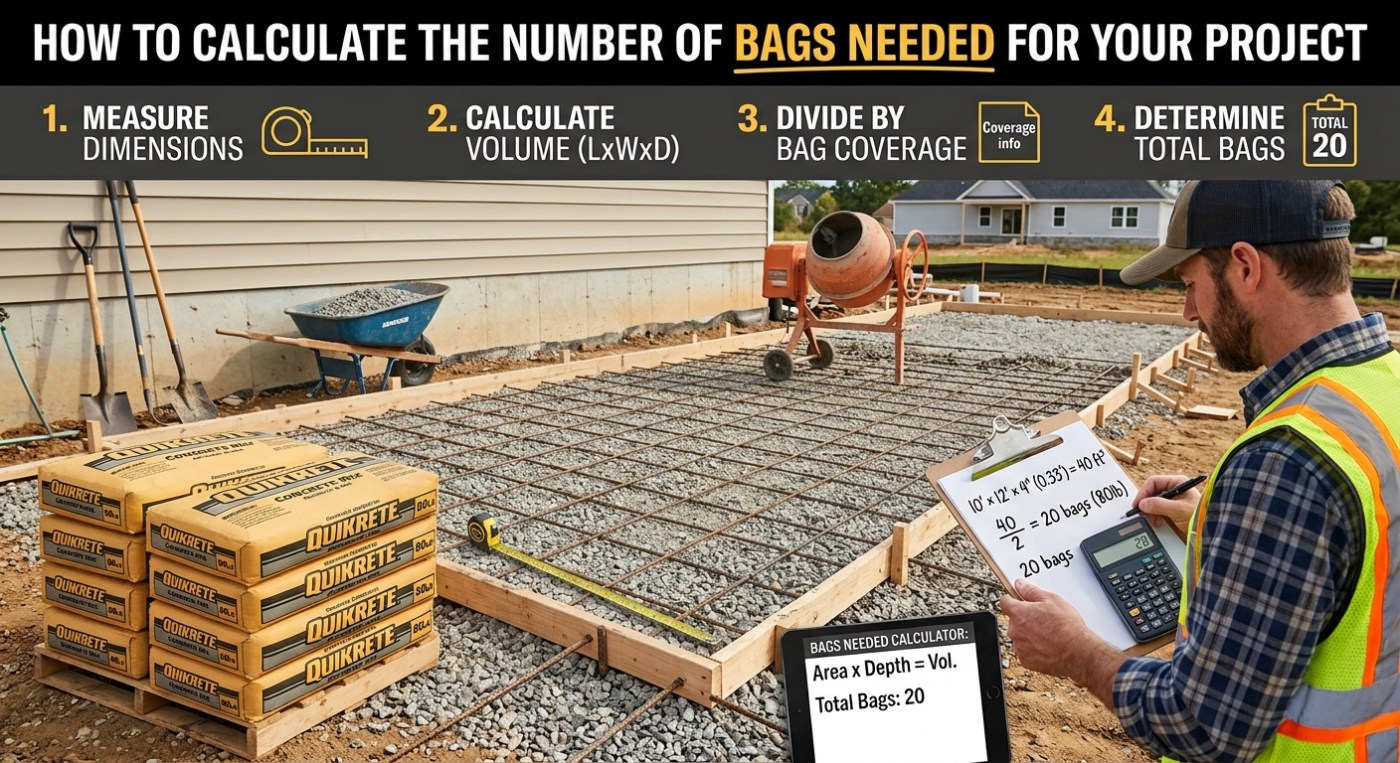
Planning a project often comes down to one simple question: how many bags do you need? Whether you’re buying bags of concrete, cement, soil, mulch, gravel, sand, or another material, getting the amount right can save money and prevent extra trips to the store.
The good news is that you don’t need to guess. Once you know the size of the area, the amount of material each bag holds, and the product’s coverage rate, you can work out the number of bags with a simple calculation.
This guide explains how to calculate bags needed for common home and building projects. You’ll also see practical examples, the formulas you can use, and tips for dealing with waste, uneven ground, and different bag sizes.
Why Getting the Bag Count Right Matters
Buying too few bags can stop a project halfway through. You may need to make another trip, and the material you need might not be in stock.
Buying too many bags creates a different problem. Extra material costs money and may go unused, especially when it has a short shelf life or takes up a lot of storage space.
A good estimate gives you a starting point before you buy. It also makes it easier to compare products with different bag sizes.
The amount you need depends on the type of material. A bag of concrete is measured differently from a bag of mulch, while gravel and soil may be sold by weight or volume. That’s why you should always check the product label before doing the math.
The Basic Formula for Calculating Bags
For many projects, you can use this simple formula:
Number of bags = Total material needed ÷ Material per bag
You then round the answer up to the next whole bag.
For example, suppose your project needs 10 cubic feet of material, and each bag contains 2 cubic feet.
10 ÷ 2 = 5 bags
You’d need five bags.
Now imagine your result is 5.4 bags. You can’t buy 0.4 of a bag in most cases, so you’d round up and buy six bags.
The formula is simple, but finding the total material needed can take a few more steps.
Step 1: Measure the Project Area
Start by measuring the space where the material will go.
For a rectangular area, use:
Length × Width = Area
Let’s say you’re filling a garden bed that is 12 feet long and 4 feet wide.
12 × 4 = 48 square feet
Your area is 48 square feet.
For a square, multiply one side by itself. For a circle, you’ll need the radius and the formula for the area of a circle.
Accurate measurements matter. Even a small error in length or width can change the amount of material you need.
Step 2: Add the Depth
Area alone isn’t enough when you’re filling a space with soil, mulch, gravel, sand, or another loose material. You also need the depth.
For a rectangular space, use:
Length × Width × Depth = Volume
Make sure all three measurements use the same unit.
For example, if your garden bed is 12 feet long, 4 feet wide, and 0.25 feet deep:
12 × 4 × 0.25 = 12 cubic feet
You need 12 cubic feet of material.
Depth is often given in inches. In that case, convert inches to feet before using the formula.
For example:
3 inches ÷ 12 = 0.25 feet
That lets you use the same unit for length, width, and depth.
Step 3: Check How Much One Bag Covers
This is where product labels become useful.
Some bags list their volume directly, such as 1 cubic foot or 2 cubic feet. Other products give a coverage rate, such as how many square feet one bag can cover at a set depth.
Always use the value provided for the product you’re buying. Two bags with the same weight may not cover the same area because different materials have different densities.
For example, if a bag of mulch covers 12 square feet at a depth of 2 inches, and your project covers 60 square feet:
60 ÷ 12 = 5 bags
You’d need at least five bags.
If the label gives coverage for a different depth, don’t use that number without adjusting your calculation.
Step 4: Divide the Total Need by the Bag Size
Once you know how much material the project requires and how much each bag provides, divide the total by the bag amount.
Imagine a project needs 15 cubic feet of soil, and each bag contains 1.5 cubic feet.
15 ÷ 1.5 = 10 bags
So, you’ll need 10 bags before allowing for waste.
When your result isn’t a whole number, round up.
For example:
15 ÷ 1.5 = 10
But:
16 ÷ 1.5 = 10.67
That means you’ll need 11 bags.
Step 5: Add a Small Extra Amount
Real projects don’t always match the math perfectly.
Ground may be uneven. Material may spill. Some soil or mulch can remain in a wheelbarrow or bag. Concrete work can also have small losses during mixing and placement.
For that reason, adding a small amount to your estimate can be useful.
A common approach is to add around 5% to 10% for normal waste and measurement differences. Bigger allowances may be needed for very uneven areas or projects where precise sizing is hard.
For example, if your calculation says you need 20 bags and you choose a 10% allowance:
20 × 1.10 = 22 bags
You’d plan to buy 22 bags.
Don’t add a large buffer without a reason. Extra material costs money, and the right allowance depends on the material and project.
Concrete Bag Calculation Example
Concrete is a common material where bag estimates matter.
Suppose you’re making a small slab that is:
10 feet long × 8 feet wide × 0.33 feet deep
The volume is:
10 × 8 × 0.33 = 26.4 cubic feet
The exact number of bags depends on the yield of the concrete mix. If one bag produces about 0.6 cubic feet of mixed concrete, the calculation would be:
26.4 ÷ 0.6 = 44 bags
You’d then review the product’s stated yield and add a suitable allowance.
The key point is that you should use the yield listed on the specific concrete product rather than assuming all bags produce the same amount.
Soil, Mulch, and Gravel Example
Let’s say you’re covering a 100-square-foot garden area with mulch at a depth of 3 inches.
Convert the depth:
3 ÷ 12 = 0.25 feet
Now calculate volume:
100 × 0.25 = 25 cubic feet
If each bag contains 2 cubic feet:
25 ÷ 2 = 12.5 bags
You’d need 13 bags before adding a waste allowance.
This same process works for many loose materials. The main difference is the bag size and how the product is sold.
What About Bags Sold by Weight?
Some materials are sold by pounds or kilograms instead of cubic feet.
In that case, don’t assume that weight and volume are interchangeable. A 50-pound bag of one material may take up a different amount of space than a 50-pound bag of another material.
When the product is sold by weight, check the manufacturer’s coverage or volume information. If you need to convert between weight and volume, you’ll need the material’s density.
For most home projects, using the manufacturer’s stated coverage is easier and less likely to cause an error.
Use a Bag Calculator for Faster Estimates
Doing the math by hand is useful, but a calculator can make the process much quicker, especially when you’re comparing bag sizes or working with several project measurements.
A Bag Calculator can help you work through the numbers without having to repeat the formula each time. You can still check the result against the product label before buying.
The calculator is most helpful when your project has several measurements or when you want to compare different bag capacities.
Common Mistakes to Avoid
One of the most common mistakes is forgetting to convert inches into feet before calculating volume. Mixing units can produce a result that’s far too high or too low.
Another mistake is using the bag’s weight as though it were its volume. Always check what the manufacturer means by the number printed on the bag.
People also forget to account for depth. A 100-square-foot area covered at 1 inch needs much less material than the same area covered at 4 inches.
Finally, don’t round down. If your calculation gives 8.2 bags, you need nine bags, not eight.
A Simple Way to Plan Your Purchase
Before heading to the store, write down three things:
Project dimensions: length, width, and depth.
Total material needed: the volume or coverage required.
Bag size or product yield: how much material one bag supplies.
Then divide the total amount by the amount in one bag and round up.
Check your final number against the product label. If the project is large, unusual, or expensive, it’s worth checking the estimate with the material supplier or a qualified professional.
Final Thoughts
Calculating the number of bags needed for a project doesn’t have to be difficult. Measure the space, calculate the amount of material required, check the bag size or coverage rate, and divide the total by the amount supplied per bag.
The right calculation can help you avoid wasted money, project delays, and unnecessary trips to the store. It also gives you a much clearer idea of what the job will cost before you start.
For simple projects, a basic formula may be all you need. For larger jobs, a bag calculator and the manufacturer’s coverage data can make the estimate faster and more reliable. Always check the product label, use consistent measurements, and allow a small amount for normal waste.


Leave a Reply